Some Weight is Invisible: What Are You Carrying That’s Weighing You Down?
By Dr. Scott Zarcinas | Author, Doctor, Wayfarer
In this article:
- What invisible weight are you carrying?
- The trap of trying harder.
- Misplaced effort.
- Why more strategies won’t help.
- What changes when the weight drops.
Invisible Weight
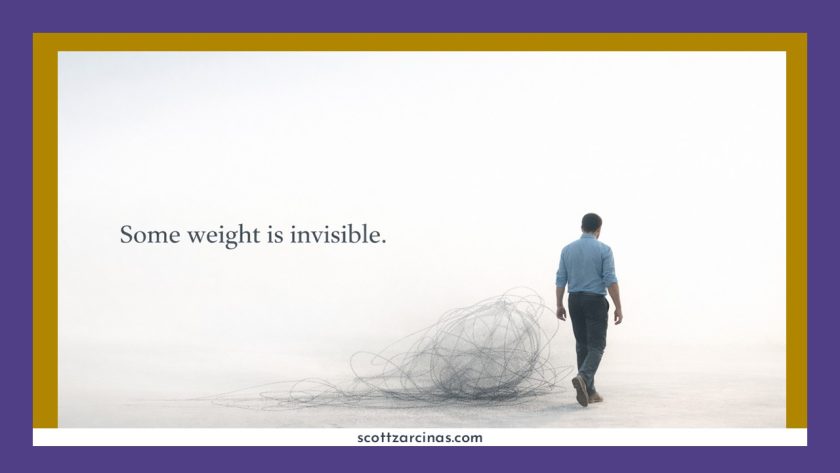
Some weight is invisible.
Not the kind you see on a scale. The kind you feel at the end of the day.
You know that feeling:
- The effort of holding things (i.e. the world) together.
- Being the responsible one.
- Carrying what nobody actually asked you to carry, but somehow became yours anyway.
- Keeping systems running, people happy, situations stable, so everyone else can just not worry about it.
Maybe it’s anticipating problems before they happen. Maybe it’s managing other people’s emotions. Maybe it’s being the one who remembers, follows up, thinks ahead, and fills in the gaps.
This kind of weight doesn’t announce itself. It creeps in quietly, building up over time through habits that probably made sense once upon a time.
You stepped up when something needed doing. You proved you were capable. And then, without anyone saying it out loud, it just became your job.
From the outside? Your life looks fine. You’re competent. Successful. The person people can count on. You’ve got it together.
From the inside? It feels heavy.
Not in a dramatic, falling-apart kind of way. You’re not falling apart. You’re still showing up, still performing, still managing.
It’s just harder than it should be. Like you’re walking through your days with a backpack full of rocks that nobody else can see.
The Trap of Trying Harder
When most of us feel this heaviness, our first instinct is to assume we need to try harder.
Optimise better. Find the right productivity system. Push through with a smarter strategy. Get up earlier. Be more disciplined. Finally figure out the one thing we’re obviously doing wrong.
But here’s the thing: That assumption is actually part of the problem.
Because this isn’t about motivation. You’re not lazy. And it’s definitely not about capability. You’ve already proven you can handle a lot.
The problem is carrying unnecessary effort for way too long.

Misplaced Effort
Much effort spent managing life instead of living it causes life and work to feel heavy.
Effort spent propping up roles, expectations, and responsibilities you never fully chose in the first place.
Effort spent keeping everything working smoothly, maintaining an image, meeting standards that maybe made sense once but don’t quite fit anymore. Even when the cost is completely invisible to everyone around you.
You’ve been compensating. Accommodating. Adjusting yourself to fit circumstances rather than questioning whether the circumstances still make sense.
Over time, all that effort calcifies into weight.
And that weight slows everything down.

Why More Strategies Won’t Help
Piling on more strategies, tools, or frameworks rarely helps because you’re just adding more to a system that’s already overloaded.
It’s like trying to run faster while wearing a weighted vest. Sure, you might get marginally faster with the right training plan, but you’d make a lot more progress by just taking the vest off.
The solution isn’t better time management. It’s not a new morning routine. It’s not working on your mindset or your resilience or your ability to push through.
What actually helps is relief.
Not the temporary kind, like a vacation you need to recover from. The real kind.
The kind of relief that comes from genuinely letting go of what doesn’t need to be carried.

What Changes When the Invisible Weight Drops
Because when that invisible weight finally drops, something fundamental shifts:
Energy comes back—not as manic excitement or forced enthusiasm, but as genuine steadiness. You wake up and there’s just more of you available. You’re not starting the day already depleted or in a negative mindset.
Decisions get simpler—not because you’re suddenly smarter or analysing them better, but because there’s less resistance in the way. Less second-guessing. Less mental negotiation with yourself about what you “should” do versus what actually makes sense.
Work feels cleaner—less emotional drain, less inner friction, less of that exhausting gap between what you’re doing and how you actually feel about it. Things just flow more naturally.
Relationships improve—because you’re not showing up depleted and resentful. You have more to give because you’re not already giving everything to things that don’t matter.
Life starts moving again—naturally, without you having to force it. Things that felt stuck begin to shift. Not because you pushed harder, but because the obstruction was removed.
All these things happen not because you added something new: a new habit, a new identity, a new version of yourself.
Because you finally put down something unnecessary.

The Real Problem with Effort
This is why all that effort hasn’t solved it. And why more effort won’t either.
If effort were the answer, it would’ve worked by now.
You’ve tried hard enough. You’ve done enough. You’ve proven yourself enough.
The issue isn’t that you need to do more or be more: It’s that you’re carrying more than you need to.
And most of that weight is invisible. Even to you.
This invisible weight is in the standards you hold yourself to that nobody else expects. The responsibilities you take on that were never actually yours. The roles you’ve outgrown but haven’t let go of. The versions of yourself you’re still trying to be because they worked once, even though they don’t fit anymore.

What it Looks Like to Put it Down
Sometimes the most powerful thing you can do isn’t doing more, fixing yourself, or becoming someone completely different.
It’s simply noticing what you’re still carrying—and realising you don’t actually need to carry it anymore.
That might look like:
- Letting someone else handle something, even if you could do it better.
- Disappointing someone whose expectations never served you anyway.
- Walking away from a responsibility that was never truly yours.
- Admitting that something you’ve been maintaining doesn’t actually matter.
- Choosing what’s easy and right for you, instead of what’s hard and proves something.
It’s not dramatic. It’s not a breakdown. It’s not falling apart.
It’s aligned with who you actually are, not who you’ve been trying to be.

Being You
At first there might be some guilt. You might feel some discomfort. Some worry about what it means or what people will think.
But underneath it all is relief.
And with relief comes something you might have forgotten was possible as an adult: lightness.
Not the absence of responsibility or purpose. But the presence of space. The lightness of being. The room to breathe. The freedom of moving through your days without that constant, invisible heaviness.
That’s what’s on the other side of the weight you’ve been carrying.
Not perfection. Not some transformed version of yourself.
Just your natural self. Moving more freely. Finally.

Find Your Way Forward
A short written guide to navigating life’s crossroads and understanding what’s weighing you down.
Navigate Life’s Crossroads
Get the Welcome Pack →