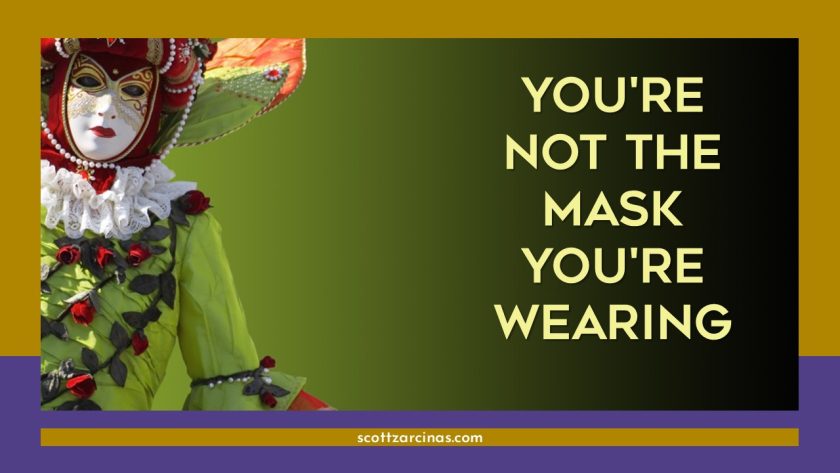
You’re Not the Mask You’re Wearing: Why maintaining your persona creates invisible weight, and what remains when it drops
By Dr. Scott Zarcinas | Author, Doctor, Wayfarer
What’s in this article:
- What your persona is—and why you’re not it.
- The invisible weight of maintaining a false identity.
- How the illusion of self creates constant effort.
- What remains when the mask finally drops.
You’re Not the Mask You’re Wearing
You can feel when you’re not being yourself.
It takes effort to hold it together. To say the right thing. To come across the right way. To be who you think you need to be in that moment—for that person, in that situation, in that role.
That effort to maintain that image?
That’s your persona at work.

The Mask We Wear
The word “persona” comes from Latin, originally referring to a theatrical mask worn by actors in ancient drama. It comes from per sonare—literally, “to sound through.”
A mask through which something speaks.
In the theatre, the mask wasn’t the actor. It was the character. The role. The performance.
The audience saw the mask, heard the voice coming through it, and believed in the character. But beneath it all was a real person—the actor—who put the mask on and would eventually take it off.
But here’s where it gets interesting.
You are not the mask. You are the one wearing it.

When We Forget
Life gets confusing when we forget that distinction. When we start thinking we are the character we’re performing.
The competent professional. The good partner. The reliable friend. The person who has it all together. The one who doesn’t need help. The strong one. The successful one. The one who never complains.
These aren’t lies, exactly. They’re roles. Faces we show the world. Ways we’ve learned to be that work in certain contexts, that get certain results, that keep us safe or accepted or valued.
But somewhere along the way, the line blurs.
We forget we’re wearing a mask. We start believing we are the mask.
And that’s when the invisible weight begins.

The Illusion of Self
This confusion of identity—believing you are the persona instead of the soul wearing it—is what spiritual traditions often call the illusion of self.
It’s not that you don’t exist. It’s that you’ve misidentified what you are.
You’ve confused the performance with the performer. The role with the reality. The mask with the face beneath it.
The problem with maintaining that illusion is that it takes constant effort.
Fixing: When the mask slips, you scramble to put it back in place. You apologise. You explain. You course-correct. You try harder to be the version of yourself that fits.
Defending: When someone challenges the persona, it feels like they’re challenging you. So you protect it. You justify. You argue. You prove you’re right, or good, or capable, or worthy.
Bracing: You live on guard, always monitoring how you’re coming across. Always checking: Am I doing this right? Do they see me the way I need them to? Am I maintaining the image?
Insisting: You double down. You cling to the identity even when it doesn’t fit anymore. Even when it exhausts you. Because letting go of it feels like losing yourself.
Over time, all that effort accumulates. It becomes an invisible weight.
The kind no one else can see, the heaviness you feel at the end of every day.

What’s Real Doesn’t Need Maintaining
Here’s what changes everything:
What is real doesn’t need maintaining.
Your soul identity—your actual self, beneath the performance—doesn’t require effort to exist.
It doesn’t need defending. It doesn’t need improving. It doesn’t need proving.
It simply is.
The persona needs constant upkeep because it’s constructed. It’s a role you learned to play. A strategy you developed. A version of yourself you built to navigate the world.
And there’s nothing wrong with that. We all have personas. They’re useful. They’re how we function in different contexts.
The problem isn’t that you have a persona.
The problem is when you think you are the persona.
Because then you’re trying to sustain something that was never meant to be permanent. You’re maintaining an identity that requires constant energy to hold in place.
And that effort? That’s the invisible weight.

The Return to Freedom
Your soul identity isn’t something you achieve. It’s not a better version of the persona. It’s not a more spiritual mask or a more authentic performance.
Your soul identity is what remains when the mask drops.
When you stop performing. Stop defending. Stop insisting. Stop maintaining.
When you let the persona be what it is—a useful tool, a contextual role, a way of engaging—without confusing it with who you actually are.
That’s the return. Not to some idealised version of yourself. Not to a fixed identity you need to find or create.
But to the self that was always there, beneath the effort. Whole. Present. Undefended.
That’s freedom.
Not freedom from life’s demands or roles or responsibilities. But freedom within them.
The freedom to play the role without becoming it. To wear the mask without forgetting your face. To engage fully without losing yourself in the performance.

The Shift
You’ll know you’re living from soul identity instead of persona when:
- Life stops feeling like a performance you have to get right.
- Criticism doesn’t shatter you—because it’s aimed at the role, not your essence.
- You can adapt to different contexts without losing your centre.
- The exhaustion lifts. Not because life got easier, but because you’re no longer carrying the weight of maintaining an illusion.
- You stop asking, “Am I doing this right?” and start simply doing it.
Because you remember: you are not the mask. You are the one who can put it on, take it off, and still be whole.
That’s the difference between functioning and being free.
And freedom? It’s been waiting for you all along.
Right here. Beneath the persona. Beneath the effort. Beneath the invisible weight.
You don’t have to achieve it. You just have to remember.
Your Free Guide to Navigating Life’s Crossroads →