The Triune Brain: 3 Science-Based Strategies to Overcome Challenges and Thrive
By Dr. Scott Zarcinas | Author, Doctor, Spiritual Coach
*Updated 17th February 2026 (Original article published 26th June 2023)
Why Motivation Collapses in Uncertain Times
Lately you might find yourself feeling increasingly anxious about various aspects of your life in these uncertain times, and struggling to regain motivation and energy.
Many individuals face similar challenges during times of uncertainty. However, it’s important to recognise that you have the power to confront these challenges and shape your own experience of them.
In times of difficulties, challenges, and even crises, it’s crucial to understand the neuroscience behind how your brain responds to uncertainty. This understanding is vital for your mental, physical, emotional, and spiritual wellbeing.
When circumstances feel unpredictable, the brain shifts its priority from growth to safety. Attention narrows. Energy is conserved. Decision-making becomes cautious.
Because once you see that what you’re experiencing is a biological response to uncertainty, the pressure eases and clarity begins to return.

A Model, Not A Replica
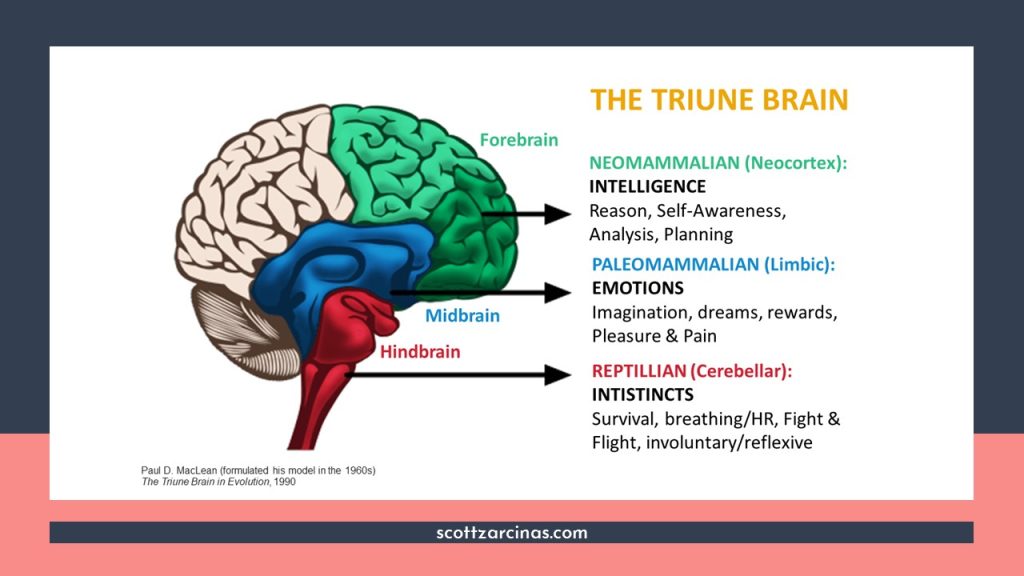
Neuroscientist Paul D. MacLean proposed the Triune Brain Model in the 1960s to describe three functional layers of the brain:
-
Reptilian (Hindbrain) – safety and survival
-
Paleomammalian (Midbrain) – emotion and bonding
-
Neomammalian (Forebrain) – reasoning, planning, principles
Remember, though, this is a model, not a literal anatomical division, but it remains helpful.
Each layer influences how you respond to stress and threats to your safety. When uncertainty rises, the lower centres activate first.
→ Your survival brain scans for threat.
→ Your emotional brain amplifies meaning.
→ Your rational brain tries to restore control.
When the lower centres dominate, interference increases.
→ Clarity narrows.
→ Emotion escalates.
→ Instinct overrides judgement.
What you experience as “loss of motivation” is often loss of internal alignment.
Below is a diagramatic representation of the Triune Brain and each part’s area of responsibility.
Interference, Not Inadequacy
When your hindbrain senses danger, it activates fight-or-flight or freeze. When your midbrain senses pain, it magnifies the story. When both run unchecked, your forebrain struggles to lead.
Although you might feel this is a character flaw or a failure at some level to cope, at its root it is simply neurobiology at work. But left unmanaged, it produces:
-
anxious overthinking
-
impulsive reactions
-
emotional fatigue
-
decision paralysis
-
spiritual disconnection
What follows is that you feel scattered. You feel reactive. You feel unlike yourself.
This is interference. And the good news is that interference can be reduced.
With this understanding of how the brain functions, let’s explore strategies to reduce interference and regain control during uncertain times.

Strategy #1: Sensible Safety
First and foremost, it’s essential to address your reptilian hindbrain’s instinctive reactions in order to regain control and get back on track.
Your nervous system will not settle until it feels safe.
Safety does not mean eliminating uncertainty. It means recalibrating your perception of threat.
It is this primal part of your brain that perceives the uncertainty of the situation as a threat, triggering the fight-or-flight response.
To manage these instinctive reactions, focus on taking sensible precautions that reduce the perceived risk to your safety.
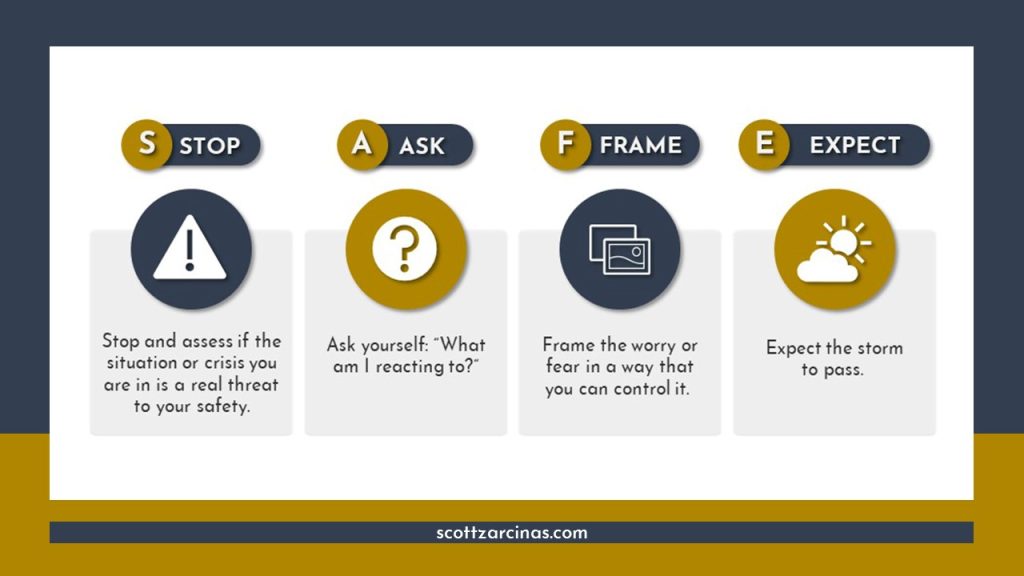
One way to think of it is to be SAFE:
-
-
- S: Stop and assess if the situation or crisis you are in is a real threat to your safety. Unless you are in imminent physical danger, your safety probably isn’t being threatened. This buys you some time to get yourself back in control.
- A: Ask yourself this question: “What am I reacting to?” Is it the worry or fear of something bad happening to you or a loved one? Is the outcome you are afraid of definitely going to happen, or is it just an anxious or worrisome improbability? That is, are you overthinking this? The chances are it probably isn’t as bad as you are making it out to be.
- F: Frame the worry or fear in a way that you can control it. For example, if you are concerned or worried about the rising cost of living and are feeling anxious about your finances, reframe this worry by writing it down on a notepad or piece of paper and then countering it with a positive solution. Just the simple act of writing it down has a calming and cathartic effect on your thoughts and emotions. It ‘clears the air’ so to speak, giving you time to re-evaluate your options and thus help you to solve the problem.
- E: Expect the storm to pass. There is no such thing as a storm that lasts forever. Even wars eventually end. So know that whatever is happening to cause you worry and fear is not going to be a permanent crisis. Eventually you will come through it. The rainy days will make way for the sunshine.
-
Implementing these ‘SAFE’ measures is a sensible approach to help you alleviate your reactive instincts and behaviors and control your reptilian hindbrain.
Simultaneously, it empowers your higher brain centres to drive responsible thoughts and actions and calm your mind so you can refocus on the things that are important to you.
When safety perception improves:
-
your body relaxes
-
breathing slows
-
stress hormones decrease
-
cognitive bandwidth returns
You cannot reason your way out of panic. You must first regulate it.
Strategy #2: Change the Context
The next key to maintaining motivation during challenging and stressful times is to manage the emotional reactions triggered by your paleomammalian midbrain.
The midbrain thrives on narrative. When stress rises, it generates meaning quickly, and often catastrophically.
Then the uncertainty of the situation you are facing leads to anxiety, stress, and fear. Your midbrain perceives this uncertainty as pain and seeks to avoid it by imagining worst-case scenarios.
This is where context matters. Instead of suppressing the emotion, widen the frame.
To regain control over your emotions, it’s important to change the context of your thoughts and emotions. This involves engaging your higher reasoning centres.
Inserting a “but” after stress-evoking thoughts or emotions can help shift your perspective. Here are some common scenarios of worrisome thoughts and stressful emotions and how you can insert a ‘but’ to negate them and regain control:
-
-
- “Nobody finds me attractive and I’ll never find a partner.” BUT there are plenty of fish in the sea, and if I take care of myself and visualise myself in a warm and positive relationship, then I will attract the right person at the right time.
- “I’ll never be able to save up enough money to travel overseas.” BUT if I make a saving plan of cutting out non-essential spending and putting aside $50 a week, I’ll save $2,500 in a year, and save $12,500 in 5 years, more than enough to go on that holiday I’ve always wanted. (You can use this same strategy to save up for any goal you have your heart’s desire on, such as a new car, a bond for a house, a wedding dress, or kitchen or bathroom renovations.)
- “I’m just not lucky. I always attract bad luck in everything I do.” BUT, as the saying goes, you make your own luck. So that’s what I’ll do. I’ll make my own luck by preparing for the opportunity when it comes along—and opportunities come along all the time, so I’ll make sure I’m as prepared as I can be for when they come.
- “God appears so distant, even non-existent. I doubt He even exists.” BUT, I do believe in something greater than myself, and the doorway to experiencing this Greater Presence is through the consciousness of my own presence, so that’s where I’ll start.
-
These are just some everyday examples of how you can easily change the context from a negative, stress-evoking one to a more positive, motivational one.
Doing so will help you to control your midbrain emotions and allow your more rational, higher centres of the brain to take charge. This is how you reduce interference so you can reclaim your sense of self-determination and self-guidance.
When the forebrain re-engages:
-
emotional intensity decreases
-
nuance returns
-
impulsivity softens
The goal is not to deny emotion. It is to prevent emotion from defining reality.

Strategy #3: Focused Certainty
The third key to maintaining motivation during challenging times is to refocus on your thought processes.
It’s common for your higher brain centres to become overwhelmed by the negative emotions and instincts from your lower brain centres, especially in times of crisis. However, your neomammalian forebrain seeks certainty above all else. This it does through orientation.
When the external world feels unstable, the mind searches for reference points.
You always have anchors available. To regain control of your thoughts, practice focusing on what is certain in your life. By shifting your attention to the certainties, you allow your higher-centred thoughts to override the chaotic emotions and instincts that threaten to take control.
While there may be widespread uncertainty globally, there are still aspects of your life that you can be certain about.
Instead of dwelling on what is uncertain, anchor your focus on what is certain:
-
-
- You are alive: Recognise the life force within you at this very moment. You are alive, aren’t you? This is an undeniable fact and a certainty to embrace.
- You have beliefs and values: Whether religious, atheistic, or agnostic, you hold beliefs that provide a sense of certainty. Beliefs can only arise because you have consciousness. Acknowledge and focus on these conscious beliefs. They are yours, nobody else’s, that’s for certain.
- You are conscious: Despite the challenges, you know that you exist. This is a dependable certainty to anchor your thoughts.
- Love exists: Love manifests in various forms, be it familial, romantic, for pets, for yourself, or even for a higher power. Acknowledge the presence of love as an undeniable certainty that lives as you, in you, and through you. Love is who you are, your soul identity.
-
There are numerous certainties to draw upon, and by focusing on them, you regain control over your thought processes, preventing overwhelm during uncertain times.
But certainty does not mean control over the world. It means clarity about what remains true.
When you focus on what is stable:
-
thinking sharpens
-
overwhelm decreases
-
motivation reorganises
Your higher brain resumes leadership.

Where Soul Identity Enters
From a neurological perspective, regulation restores function. From a spiritual perspective, regulation restores access.
When the nervous system settles, the brain resumes integration. Higher reasoning reconnects with emotional tone. Instinct stops dominating perception.
But something else also becomes available.
When fear quietens and emotional reactivity eases, a subtler layer of experience becomes perceptible: presence, clarity, a quieter sense of self that is not defined by what is happening but by what is being (i.e. that which is prior to thoughts, emotions, and behaviour).
Most people mistake this for “calming down”, but it is the re-emergence of orientation.
This is what I refer to as soul identity, the stable reference point beneath changing roles, moods, achievements, and setbacks. It does not fluctuate with circumstances. It does not rise and fall with outcomes.
It remains, permanent and present—your true self.

You do not become a new person. Your identity is, has been, always will be, soul. What happens is that you stop misidentifying yourself with the external layers and return your identity to the permanent essence of who you really are.
- Motivation returns without forcing.
- Decisions simplify without overthinking.
- Energy reorganises without pressure.
- Action feels cleaner because it is no longer compensatory.
Rather than being a performance upgrade, it is what naturally expresses when identity is no longer fragmented by fear and stress.

Final Perspective
Uncertainty is part of life. The brain will always respond to threat signals. Instinct will always scan for safety. Emotion will always seek to amplify and escalate. Logic will always seek control and certainty.
The work is not eliminating these layers of the Triune Brain. The work is integrating them.
When the Triune Brain works with you instead of against you, interference drops. When interference drops, alignment naturally returns. And when your are aligned with your soul identity, you do not need to manufacture motivation.
You are simply clearer about who you are and what to do next.

Let the Weight Drop
A short written guide to understanding what’s weighing you down and how it releases.
Get the Welcome Pack
No fixing. No pressure. Just clarity.